

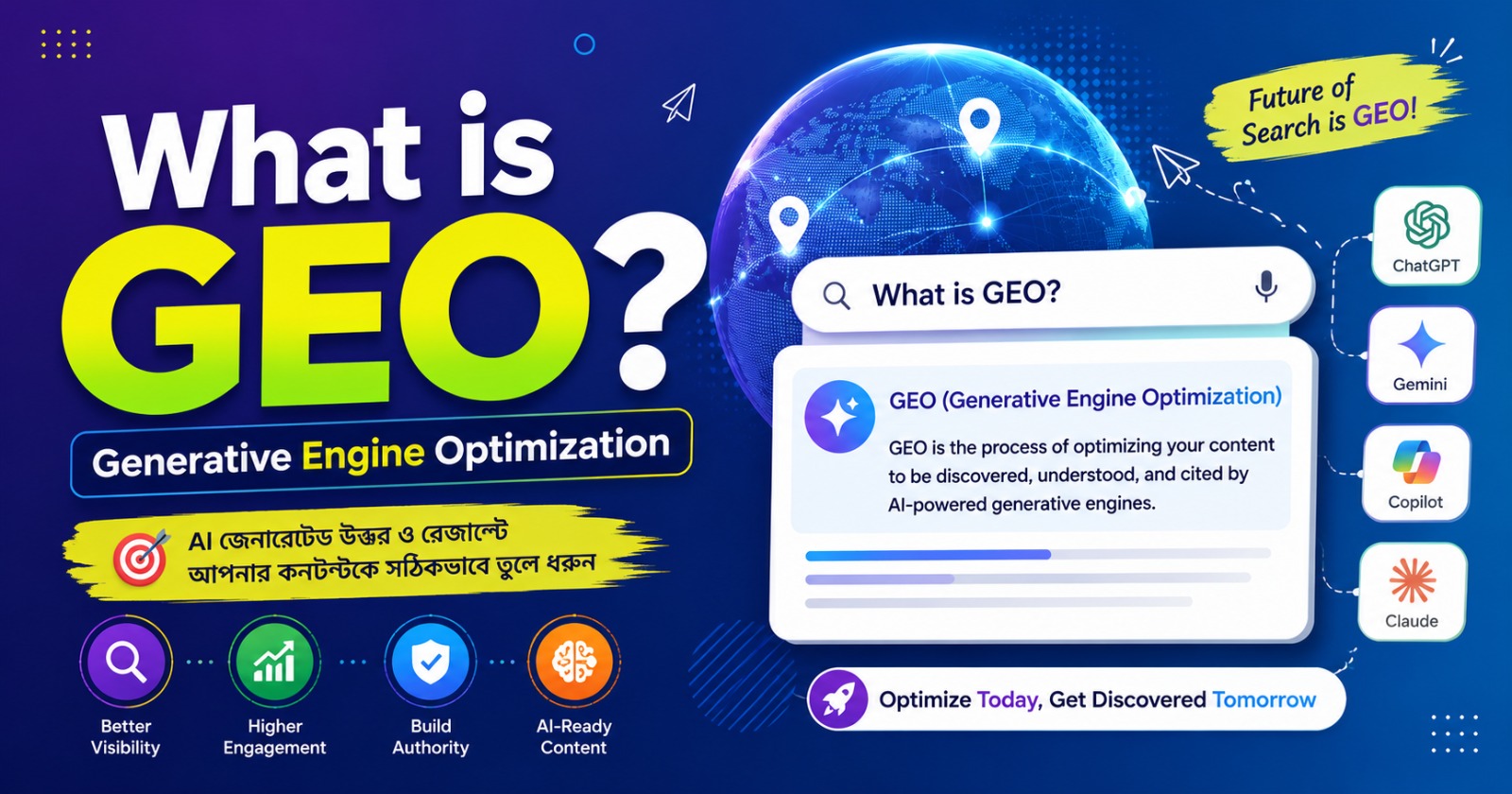
What is GEO? A Complete Guide to Generative Engine Optimization
Search engine optimization has changed dramatically over the past two decades. Websites once focused almost entirely on ranking in traditional search engines by targeting keywords and earning backlinks. Today, a new challenge has emerged. Artificial intelligence is transforming how people search for information, and businesses need to adapt to stay visible.
This shift has introduced a new concept known as Generative Engine Optimization (GEO). If you’ve recently come across the question “What is GEO?”, you’re not alone. As AI-powered search experiences become more common, understanding GEO is becoming essential for website owners, marketers, bloggers, and businesses of all sizes.
In this guide, we’ll explore what GEO is, why it matters, how it differs from traditional SEO, and the best practices you can use to prepare your website for the future of search.
What is GEO?
The simplest answer to What is GEO is that it stands for Generative Engine Optimization. GEO is the process of optimizing digital content so that AI-powered search engines and generative AI platforms can understand, reference, and recommend it when answering user questions.
Unlike traditional search engines that display a list of websites, generative engines create complete answers by combining information from multiple trusted sources. Your content may be summarized, quoted, or referenced directly within these AI-generated responses.
The primary goal of GEO is not just to rank high in search results but to become a trusted source that AI systems rely on when generating answers.
Why GEO Matters
AI-powered search tools are changing user behavior. Instead of clicking through multiple search results, many users now expect immediate, conversational answers.
This trend creates new opportunities for businesses. If your content is recognized as reliable and authoritative, it has a greater chance of appearing in AI-generated responses, increasing your visibility and brand credibility.
Learning What is GEO today helps you prepare for tomorrow’s search landscape rather than reacting after the shift has already happened.
How GEO Differs from Traditional SEO
Although GEO and SEO share several principles, they are not identical.
Traditional SEO focuses on improving rankings in search engine results pages. Success is often measured by keyword rankings, organic traffic, and click-through rates.
Generative Engine Optimization focuses on helping AI systems understand your content well enough to reference it confidently. Rather than simply ranking pages, GEO emphasizes providing clear, accurate, and trustworthy information.
Here are some important differences:
| Traditional SEO | GEO |
|---|---|
| Optimizes for search rankings | Optimizes for AI-generated answers |
| Targets keywords | Focuses on answering user intent |
| Prioritizes backlinks | Prioritizes authority and factual accuracy |
| Measures organic traffic | Measures AI visibility and citations |
| Encourages keyword optimization | Encourages semantic clarity and context |
Instead of replacing SEO, GEO complements it. Businesses should invest in both strategies.
How AI Search Engines Choose Content
Understanding What is GEO also requires understanding how AI systems evaluate information.
Generative AI models look for content that demonstrates:
- Clear organization
- Accurate and verifiable information
- Strong topical authority
- Helpful explanations
- Reliable sources
- Updated content
- Natural language
Content that is confusing, outdated, or overly promotional is less likely to be used in AI-generated responses.
Best Practices for GEO
1. Create Content That Answers Questions
AI systems are designed to answer user questions directly.
Instead of writing vague articles, focus on solving specific problems. Include definitions, step-by-step instructions, examples, and practical advice.
Question-based headings such as “What is GEO?” or “How does GEO work?” help both readers and AI systems understand your content.
2. Build Topical Authority
Publishing a single article is rarely enough.
Develop comprehensive content around your niche by creating related guides, tutorials, FAQs, case studies, and comparison articles.
When your website consistently covers a subject in depth, AI systems are more likely to recognize it as an authority.
3. Prioritize Accuracy
Generative AI values trustworthy information.
Before publishing, verify statistics, definitions, and factual claims. Update outdated articles regularly to maintain credibility.
Accuracy is becoming just as important as optimization.
4. Write Naturally
One of the biggest mistakes in modern content marketing is writing only for algorithms.
Instead, write for real people.
Use conversational language, explain concepts clearly, and avoid unnecessary repetition of keywords.
If you’re explaining What is GEO, make sure every section genuinely helps readers understand the concept.
5. Improve Content Structure
Well-organized content is easier for both humans and AI systems to process.
Use:
- Clear headings
- Short paragraphs
- Bullet lists
- Tables
- FAQs
- Logical content flow
Structured information improves readability and increases the chances of being referenced by AI.
6. Demonstrate Expertise
AI models favor content written by knowledgeable sources.
Share original insights, practical experience, research findings, and real-world examples whenever possible.
Generic content is becoming easier for AI to recognize and less valuable to users.
Is SEO Still Important?
Absolutely.
Many people wonder whether GEO will replace SEO.
The answer is no.
Traditional search engines continue to generate billions of searches every day. SEO remains essential for improving website rankings and attracting organic visitors.
However, AI-powered search is growing rapidly, making GEO an important addition to your digital marketing strategy.
The most successful businesses will combine strong SEO practices with GEO-focused content creation.
Common GEO Mistakes
As businesses begin adopting GEO, several common mistakes appear repeatedly.
These include:
- Publishing thin or low-quality articles
- Overusing keywords unnaturally
- Ignoring user intent
- Creating content without expertise
- Failing to update outdated information
- Writing solely for search engines instead of readers
Avoiding these mistakes can significantly improve your long-term visibility.
The Future of GEO
Artificial intelligence is expected to become an even larger part of online search over the coming years.
Voice assistants, AI chatbots, intelligent search engines, and personalized recommendation systems will increasingly depend on reliable web content.
As these technologies evolve, businesses that understand What is GEO and implement its principles will be better positioned to reach new audiences.
Rather than chasing algorithms, successful brands will focus on creating genuinely helpful, accurate, and trustworthy content.
Final Thoughts
So, What is GEO?
Generative Engine Optimization is the practice of optimizing content for AI-powered search engines and generative platforms that provide direct answers instead of traditional search result lists.
While SEO remains an essential part of digital marketing, GEO represents the next evolution of online visibility. Businesses that invest in clear, authoritative, and user-focused content will be better prepared for the future of search.

Leave a Reply